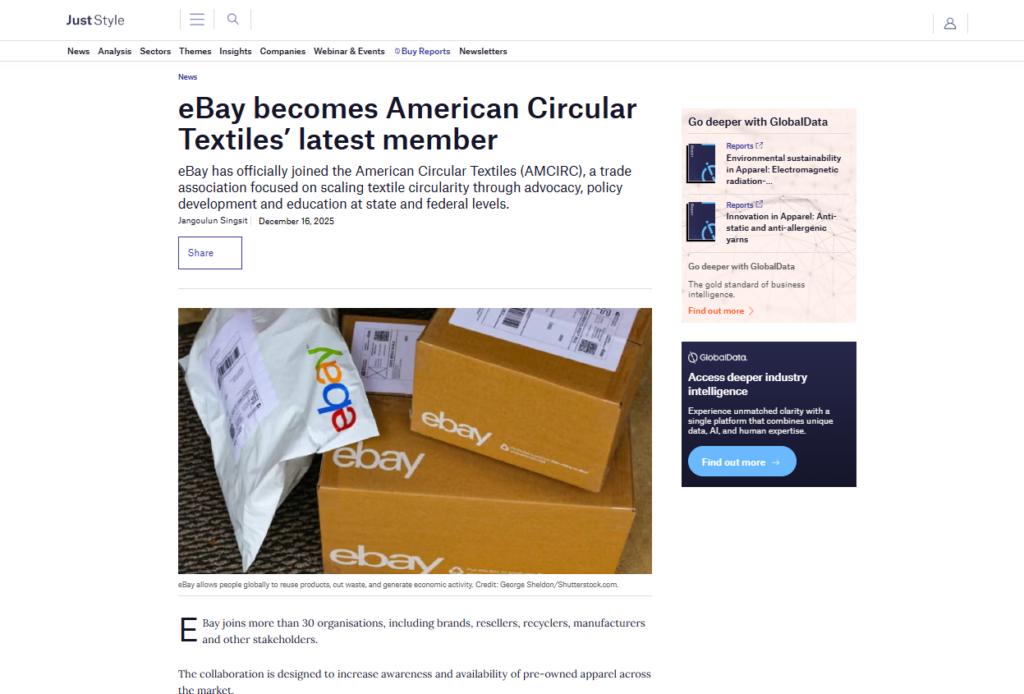
In a move that strengthens its long‑standing role in sustainable commerce, eBay has officially joined American Circular Textiles (AMCIRC), a trade association dedicated to advancing textile circularity across the United States. The announcement marks a significant step for the e‑commerce giant, which has been synonymous with resale culture since the 1990s.
For editorial photographers like George Sheldon, who has spent decades documenting economic and cultural shifts across the Mid‑Atlantic, this development offers a compelling visual narrative: the intersection of sustainability, policy, and consumer behavior.
A Major Player Steps Into the Circularity Arena
AMCIRC, founded in 2022, brings together more than 30 organizations—including brands, recyclers, manufacturers, and resellers—to advocate for circular fashion at both state and federal levels. Their work includes supporting Extended Producer Responsibility (EPR) legislation, advising on national policy proposals, and participating in global initiatives such as G7 circular design actions.
eBay’s membership adds a powerful voice. As Renee Morin, the company’s chief sustainability officer, noted, the partnership is a “natural extension” of eBay’s commitment to sustainable commerce. The company’s 2025 Recommerce Report found that more than half of surveyed consumers say buying second‑hand helps them express personal style—a trend that continues to reshape the apparel industry.
A Visual Story Rooted in Real Communities
For photographers focused on editorial storytelling, the circular fashion movement is rich with imagery:
Thrift stores and recommerce hubs
Textile recycling operations
Local fashion entrepreneurs
Community‑based sustainability programs
This is where George Sheldon’s editorial approach shines. His work often highlights the everyday people and places behind major economic trends—making him uniquely positioned to document how circularity initiatives impact real communities.
eBay’s involvement with AMCIRC, combined with its partnerships with organizations like Condé Nast and the Global Fashion Agenda, signals a broader shift toward mainstream acceptance of circular fashion. These developments create opportunities for visual coverage that blends business reporting with human‑centered storytelling.
Why This Matters for Editors and Publishers
Circular fashion is no longer a niche topic. It’s a policy issue, a business strategy, and a cultural movement. Publications covering sustainability, retail, economics, or regional industry trends increasingly need authentic, editorial‑grade imagery to accompany their reporting.
That’s where photographers like George Sheldon—who brings both regional expertise and a journalist’s eye—play a vital role.
For readers and editors seeking the original reporting, the full article is available on Just‑Style:
https://www.just-style.com/news/ebay-amcirc-textile-circularity/