AI in Photography: The Good, the Bad, and the Unavoidable Future
Artificial Intelligence continues to reshape the photography world, and a recent article from Professional Photo Online offers one of the most comprehensive looks at how AI is influencing everything from editing workflows to ethics, competitions, and even global regulation. You can read the full article here: https://professionalphoto.online/professional-photo-online-photography-news/ai-in-photography-the-good-the-bad-and-the-ugly/
As someone who works daily in editorial, real estate, and documentary photography, I’m watching this shift closely — because AI isn’t just a trend. It’s a structural change in how images are created, processed, judged, and consumed.
AI as a Tool — Not a Replacement
The article opens with a quote from Sam Altman: “AI is a tool, not a creature.” And that’s the heart of the debate.
AI-powered editing tools like Imagen AI, PortraitPro, Topaz Labs, DxO PhotoLab, Skylum Luminar, and Adobe Sensei are now deeply embedded in mainstream workflows. They automate exposure correction, noise reduction, masking, sky replacement, sharpening, and batch editing — often with uncanny accuracy.
For photographers, this means:
- Faster turnaround
- More consistent edits
- Less time spent on repetitive tasks
- More time available for creative decision‑making
But it also raises questions about authorship, authenticity, and transparency.
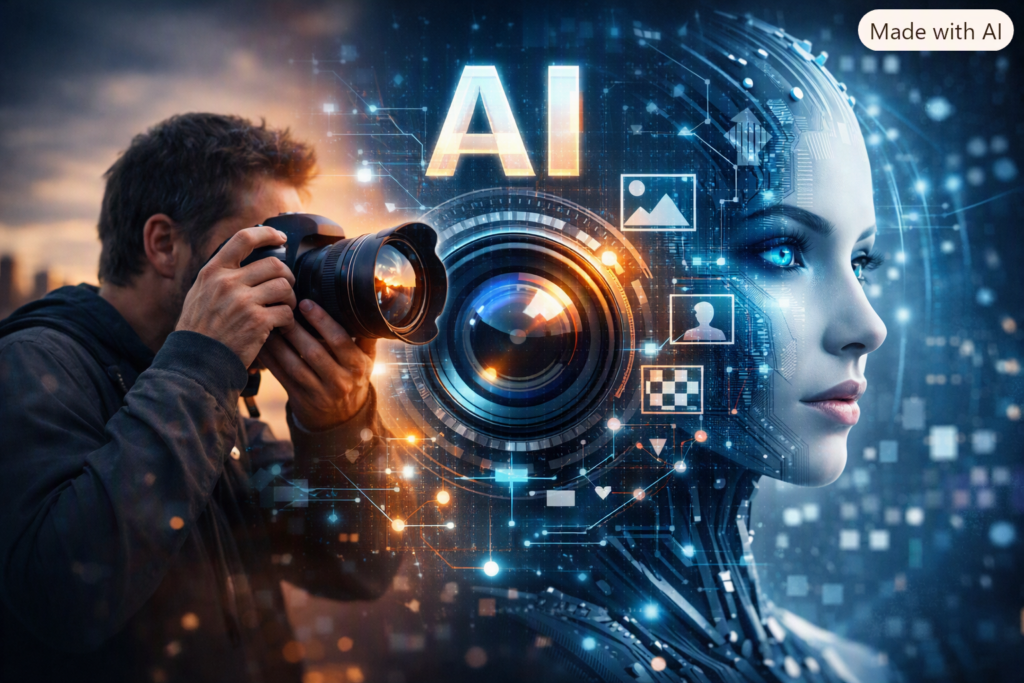
AI can:
- Add or remove objects
- Alter colors
- Generate entirely new scenes
- Create composite images from datasets
Should AI‑Assisted Photos Be Labeled?
Professional Photo Online highlights a growing debate: Should AI‑assisted images be clearly differentiated from human‑created photographs?
This blurs the line between photography and digital illustration. The article suggests that metadata standards may eventually evolve to include AI‑specific tags indicating:
- Type of AI used
- Degree of AI involvement
- Purpose of the AI edits
Right now, no universal standard exists — but competitions, agencies, and publishers are already pushing for clarity.
AI in Photo Competitions
The article makes a strong point: competitions must establish rules.
Possible requirements include:
- Mandatory disclosure of AI use
- Separate categories for AI‑assisted work
- Judges trained to identify AI‑generated imagery
This is especially important as tools like Midjourney, Nvidia Canvas, and DeepArt.io produce images that can mimic photography with startling realism.
For editorial photographers like me, this matters. News, documentary, and street photography rely on truth. AI‑generated or heavily manipulated images simply don’t belong in those categories.
Regulation Is Coming — Fast
The article also covers global regulatory efforts:
United States
Sam Altman testified before the Senate, calling for:
- Copyright models that compensate artists
- Mandatory labeling of AI‑generated images
- Stronger oversight of AI systems
European Union
The EU is pushing a contextual regulatory framework — stricter rules for high‑risk AI applications like biometric identification.
United Kingdom
The UK is developing an AI Bill, including:
- An AI authority
- Ethical guidelines
- Requirements for transparency
- A “responsible AI officer” role
AI isn’t just a creative tool — it’s becoming a regulated technology.
Why Human Photography Still Matters
Despite the rapid rise of AI, the article reinforces what many of us already know:
- Humans bring intuition
- Humans recognize emotional nuance
- Humans adapt to unpredictable environments
- Humans connect with subjects
- Humans tell stories
AI can simulate aesthetics, but it cannot replace the human experience of being present, observing, and capturing a moment that actually happened.
My Perspective as an Editorial Photographer
I’m grateful to see publications like WorldAtlas, USA Today, and others continue to license my real photographs — images created with intention, timing, and human presence. As AI‑generated visuals flood the internet, authentic photography becomes even more valuable.
And as autumn moves forward, I’ll be out photographing more street scenes, small towns, and everyday life across Pennsylvania, Delaware, and Maryland — the kind of real, human moments AI simply cannot replicate.
I’m also expanding my distribution again by submitting fresh work to Depositphotos, adding another outlet where editors and publishers can find authentic images created by a working photographer.
Sources & Further Reading
- Professional Photo Online — AI in Photography: The Good, The Bad and The Ugly https://professionalphoto.online/professional-photo-online-photography-news/ai-in-photography-the-good-the-bad-and-the-ugly/
- EU AI Regulatory Framework (proposed)
- U.S. Senate Hearing on AI — Sam Altman testimony
- UK Centre for Data Ethics and Innovation (CDEI)