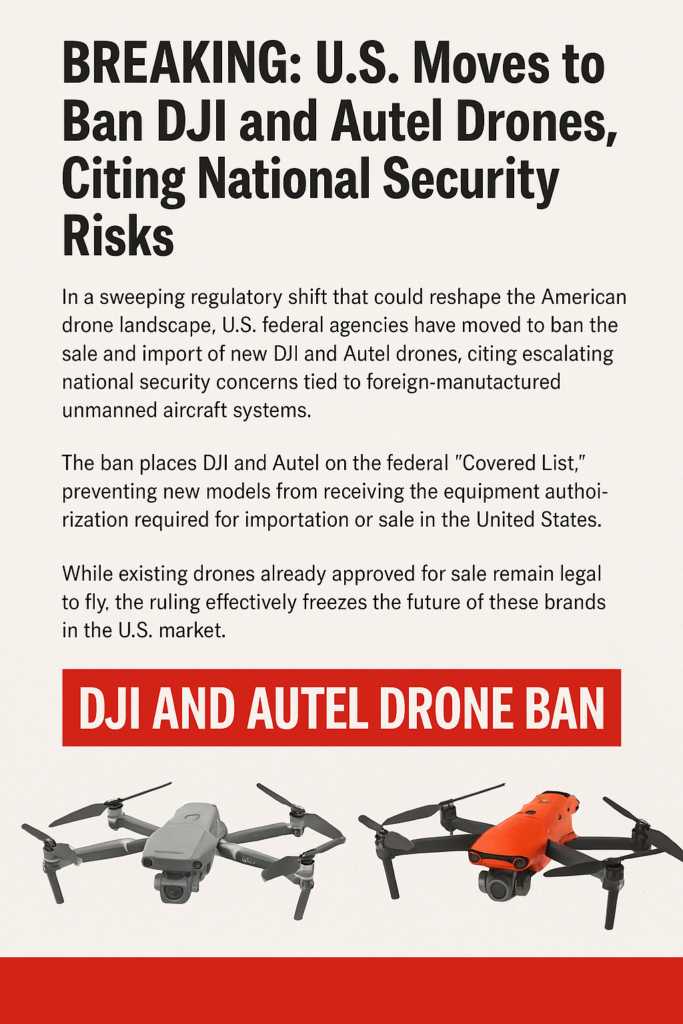
In a sweeping regulatory shift that could reshape the American drone landscape, U.S. federal agencies have moved to ban the sale and import of new DJI and Autel drones, citing escalating national security concerns tied to foreign‑manufactured unmanned aircraft systems. The decision marks one of the most significant actions the U.S. government has taken against Chinese drone makers, which currently dominate both consumer and enterprise markets.
The ban places DJI and Autel on the federal “Covered List,” preventing new models from receiving the equipment authorization required for importation or sale in the United States. While existing drones already approved for sale remain legal to fly, the ruling effectively freezes the future of these brands in the U.S. market.
Existing Drones Still Allowed — For Now
Federal officials clarified that the ban does not ground drones already in the country. Retailers may continue selling existing inventory, and pilots may continue flying their current aircraft. However, no new DJI or Autel models can enter the U.S. unless they receive explicit clearance from national security agencies — a process analysts say is unlikely.
This means that once current stock is depleted, American consumers, photographers, and public‑safety agencies will face a dramatically reduced set of options.
Why the Ban Happened
The move follows years of warnings from federal agencies about potential risks associated with foreign‑made drones, including:
Data transmission vulnerabilities
Unauthorized surveillance concerns
Supply‑chain security issues
Potential exploitation by foreign governments
The U.S. government has increasingly pushed for domestic drone manufacturing, arguing that reliance on Chinese technology poses unacceptable risks.
Impact on Photographers and Newsrooms
For editorial photographers like George Sheldon, who frequently uses drones to document Pennsylvania towns, infrastructure, and regional stories, the ban introduces uncertainty into long‑term gear planning. DJI has long been the industry standard for aerial imaging, offering unmatched stability, sensor quality, and reliability.
With new models blocked, photographers may face:
Limited upgrade paths
Higher costs for U.S.‑made alternatives
Reduced innovation in the short term
Potential repair delays if parts become harder to source
The ban also affects newsrooms, real‑estate photographers, surveyors, and public‑safety agencies that rely heavily on DJI and Autel platforms.
A Turning Point for the Drone Industry
This decision signals a major shift in U.S. drone policy. While it does not ground existing aircraft, it effectively ends the pipeline of new DJI and Autel technology entering the country. Analysts expect American manufacturers to accelerate development, but it may take years before domestic drones match the capabilities and price points of their Chinese competitors.
For now, the drone community is bracing for a period of uncertainty — and potentially, reinvention.
Breaking news blog post about the U.S. banning new DJI and Autel drones.